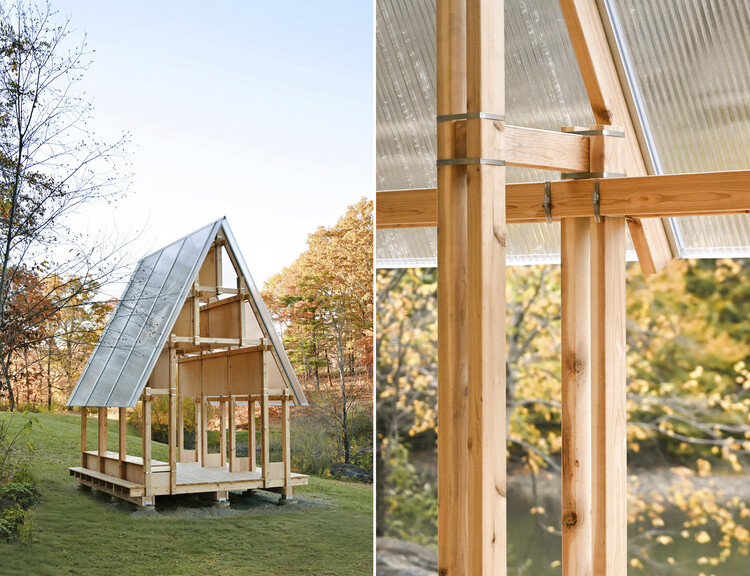
This architecture and interior design briefing examines two responses to resource pressure: reversible timber construction designed to reduce building waste, and Berlin products that use limited materials and passive principles. For photographers, both developments offer clear visual subjects, from exposed assembly systems to compact objects that make environmental performance visible.
Building and Unbuilding: An Approach to Circular Timber Construction Addressing Material Waste
Project (Un)Build is researching reversible timber construction that allows components to be assembled and taken apart rather than treated as permanent connections. Straps and friction pads replace more fixed joining approaches, supporting the reuse of materials and addressing construction waste. The initiative places “building and unbuilding” at the centre of its investigation, considering not only joints and intersections but also material weight, strength and the wider consequences of construction. For photographers, the system offers a strong opportunity to document how architecture can reveal its own assembly logic: close views of straps, friction points and separable timber elements can explain circularity more clearly than finished surfaces alone. Photographing both assembly and disassembly would make the material-reuse strategy legible.
Young Berlin designers do more with less at Find Attached exhibition
Berlin’s inaugural Find Attached exhibition presented products by 14 emerging designers focused on doing more with limited resources. Among them were a folding sink and a room divider that functions as natural air conditioning without electricity. Designed by Garance Pröbsting, the divider uses a built-in reservoir to wet textile material, while air passing through its central opening produces a cooling effect. Founded by Jonas Paul Spieker, Mia Pahl and Jul Gross, the exhibition occupied part of a former 1900s shutter factory during the Currents festival and gave local designers a platform outside major international design weeks. Photographers can look beyond object portraits: views showing folding mechanisms, water storage and airflow communicate how small design decisions support resource-conscious living.