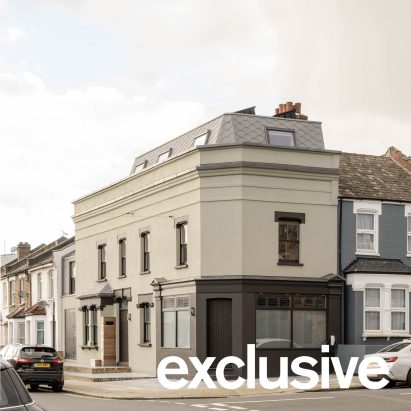
Today’s architecture and interior design briefing connects two scales of practice: Fieldwork’s dramatic conversion of a London building, and the International Union of Architects’ call for more equitable housing. Both offer photographers clear subjects: material contrast, spatial transformation, and the social consequences of design.
Fieldwork turns dilapidated building into mansard-roof-topped home and studio
Fieldwork has converted a run-down west London building into a 245-square-metre home and casting studio by stripping back the original two-storey structure and expanding it by more than 60 per cent. A new mansard roof and double-height side infill extension create a three-storey arrangement, with the casting studio at ground level, a two-storey apartment above and a roof terrace. Zinc shingles cover both additions, contrasting their textured surfaces with the rendered existing façade and making the boundary between old and new especially legible in photographs. Inside, a bespoke timber and glass partition separates the bedroom from the stair landing while preserving visual connection to the terrace. Photographers can use material contrast, vertical circulation and changing ceiling heights to explain the project’s transformation.
On World Architecture Day 2026: A Call to Build Better, Build Differently, and Share Resources
The International Union of Architects is using World Architecture Day to frame housing as a human right rather than a luxury asset. Its call addresses the global housing crisis as more than a shortage of buildings, pointing to barriers involving affordability, governance, ownership, displacement and access to formal housing. The UIA urges architects to combine design thinking with practical action, including shared-ownership models, alternative forms of cohabitation, sustainable construction systems, policy work and public education. The notes cite more than three billion people without adequate housing, over 1.1 billion living in informal settlements and hundreds of millions experiencing unrecorded homelessness. For photographers documenting architecture, the brief is to look beyond finished façades and record how design responds to vulnerability, changing populations and unequal access.