This architecture and interior design briefing examines two contrasting approaches to spatial photography: Tato Architects’ family home on an exceptionally small Tokyo lot, and Lee Broom’s atmospheric presentation of modular glass-block lighting. Together, they offer practical lessons in documenting constrained architecture and designed light.
House in Musashi-koyama
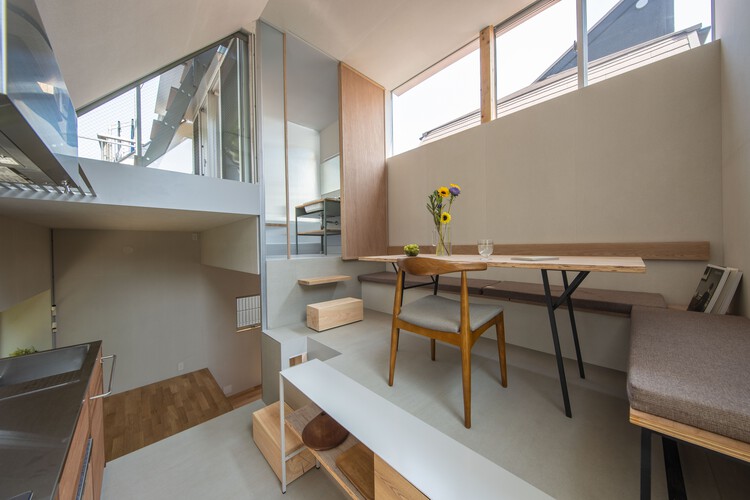
Tato Architects and Yo Shimada designed House in Musashi-koyama for a family of four on a flag-shaped lot measuring less than 40 square metres in a dense residential district of Tokyo. Completed in 2020, the project demonstrates how a very restricted site can become the central photographic subject rather than a limitation to hide. Images by Shinkenchiku Sha document the completed home, making the relationship between the compact plot, the surrounding urban density and the family-scale programme especially relevant to architectural photographers. When approaching similarly tight residential work, establish the site’s unusual geometry and neighbourhood context before concentrating on individual rooms; wide views and carefully chosen transitions can explain the design more effectively than isolated details alone.
Lee Broom evokes 1970s glamour with The Chant Chambers installation
Designer Lee Broom created The Chant Chambers as an atmospheric environment in his Shoreditch showroom, presenting the glass-block Chant lighting collection during London Design Festival. The installation shows the modular system in several configurations: portable lamp, wall lamp, linear pendants and oversized chandeliers. For photographers, the project offers a clear study in how repeated components can produce different spatial identities through scale, placement and grouping. Rather than treating each fixture as a standalone product, document how the variations shape the showroom’s atmosphere and guide the eye through the space. A useful visual sequence should distinguish the individual lighting forms while also revealing their collective effect, especially where the installation’s 1970s glamour depends on accumulation and contrast.