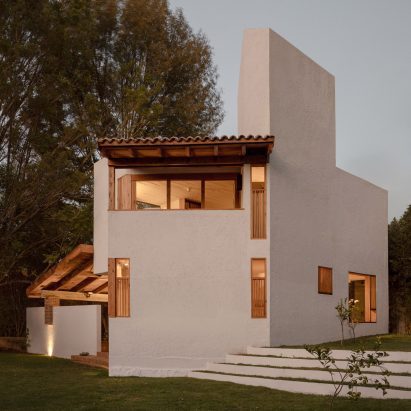
This architecture and interior design briefing examines two residential projects that challenge standard domestic layouts. Casa Amona uses angled volumes to engage a wooded hillside while accommodating extended family, and a Chongqing stacked villa experiments with freer movement for one resident. For photographers, both projects offer clear lessons in reading spatial sequence, scale and context.
Colar angles home and studio to face surrounding hills in Mexico
Colar’s Casa Amona combines a two-storey home and studio beside a wooded hillside in San Cristóbal de las Casas, Mexico. White lime-rendered walls and angled forms orient the 155-square-metre residence toward the surrounding hills, making the relationship between architecture and landscape central to any photographic reading. Designed for multi-generational living, the project includes a one-bedroom house that can be adapted into a two-bedroom arrangement, as well as a studio and guest bedroom. The changing geometry should help photographers look beyond frontal elevations and document how walls frame views, movement and outdoor context. The practical takeaway is to treat the hillside and the building’s angled openings as equally important subjects when establishing composition.
Split-Level Apartment / Shiye Architecture Design and Research Practice
Shiye Architecture Design and Research Practice reinterprets the domestic plan in a stacked villa of approximately 200 square metres in Chongqing, China. Completed in 2026, the project is designed for the long-term residence of a single person rather than the complex requirements of multi-generational living. Its central idea, described as “living freely,” turns the arrangement of levels into a spatial experiment. For photographers, the split-level configuration calls for attention to vertical relationships, transitions and the way one space leads into another, rather than relying only on room-by-room views. Images by Tianzhou Yang identify the project’s visual documentation. A useful approach is to make circulation and changing height part of the story, using sequences that explain how the stacked home is experienced.