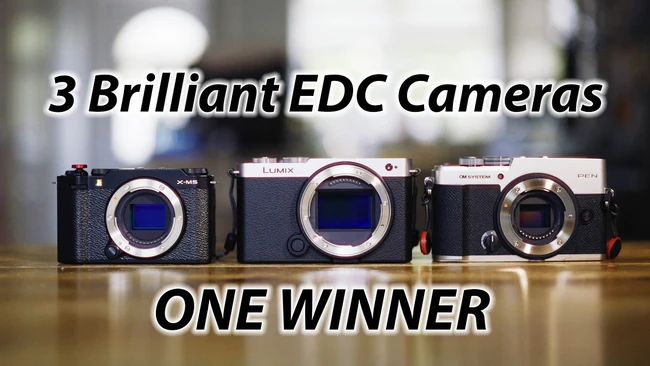
Lumix S9, Fujifilm X-M5, or OM System PEN for Everyday Carry?
A comparison of the Panasonic Lumix S9, Fujifilm X-M5, and OM System PEN shows why similar prices do not produce the same everyday camera. The S9 uses a full-frame sensor, but lacks a viewfinder and weather-sealing and relies on an electronic shutter capped at 1/8,000 sec. Fujifilm’s X-M5 adds a mechanical shutter and reaches 1/32,000 sec electronically, while also offering film simulations; it still lacks stabilization, sealing, and a viewfinder. The PEN includes an electronic viewfinder, in-body stabilization, strong face tracking, and computational tools such as Live Composite. The practical choice depends on light, weather, and lens size: compare the primes you will carry, not just the sensor format.
The Vaonis Atlas Is a Smart Telescope Crossed With a DSLR
Vaonis has announced Atlas, a modular smart telescope designed to combine the ease of the company’s other smart telescopes with an interchangeable optical system. The first module, Atlas 80, pairs an 80mm apochromatic quadruplet with a 360mm focal length and f/4.5 aperture, plus a built-in Sony IMX585 8.3-megapixel sensor. The complete Atlas 80 system weighs 14.3 pounds (6.5 kilograms) and measures 16.1 inches (41 centimeters) long. Vaonis says additional optical tubes and accessories will follow, and the platform can mount two Atlas 80 tubes in its SkyTwin configuration. For astrophotographers, that creates a system designed to expand over time, including dual-tube light gathering and mixed-filter combinations.
Best Nikon cameras in 2026 for photography and video: our top Nikon camera picks for all budgets
Amateur Photographer has published a comprehensive guide to Nikon’s Z mirrorless range, aimed at beginners, experienced photographers, and users somewhere between those levels. The guide is presented as a way to navigate Nikon’s available cameras for both photography and video across different budgets. The supplied material does not identify a single winning model or provide model-by-model specifications, so the useful takeaway is its buying approach rather than a particular recommendation. Anyone comparing Nikon bodies should use the guide’s range-wide structure as a starting point, then match a camera to their intended stills or video work and spending limit before choosing a system.