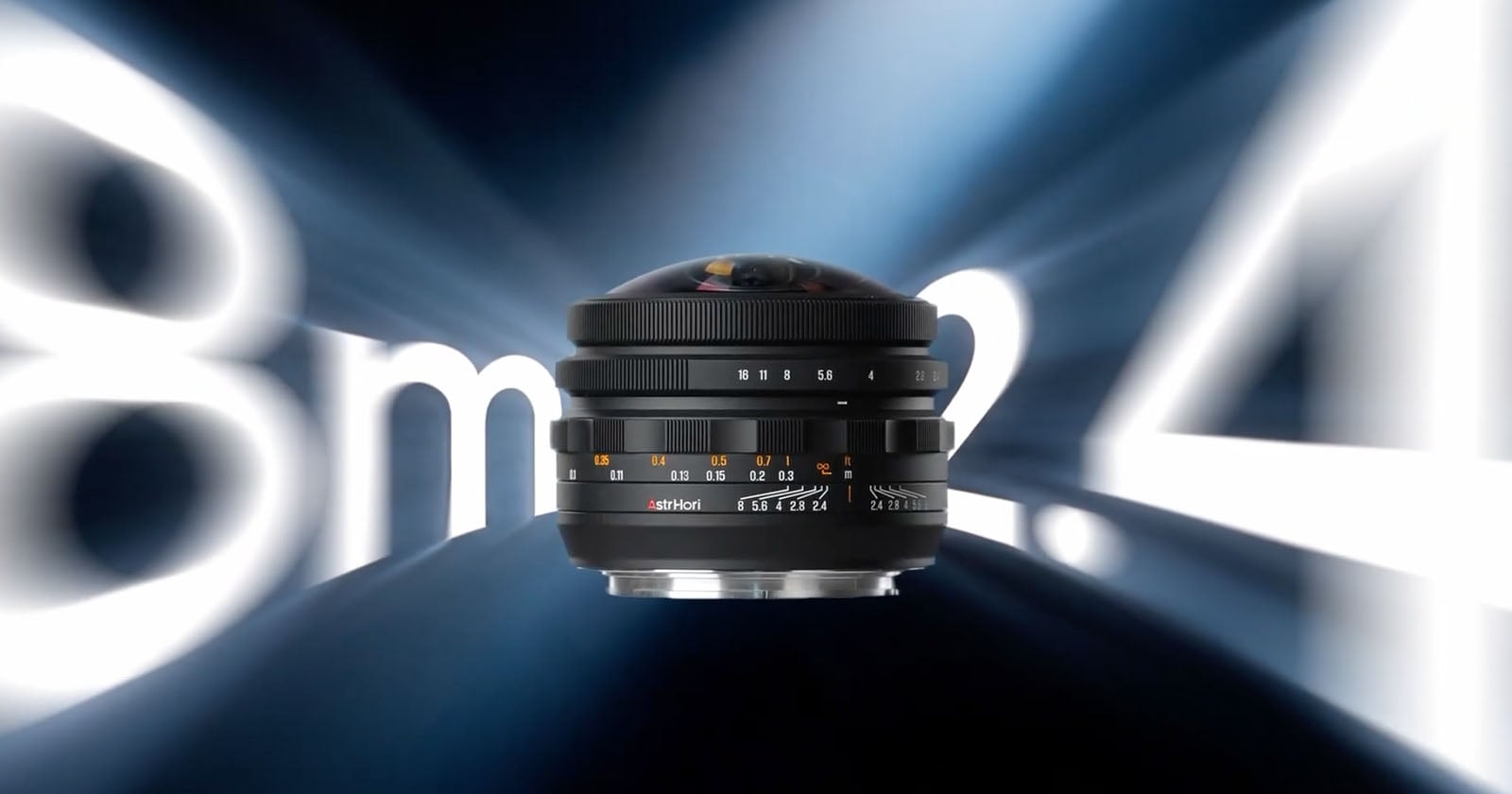
AstrHori’s 8mm f/2.4 Medium Format Fisheye Has an Expansive Field of View
AstrHori has launched the manual-focus MF 8mm f/2.4 Fisheye for Fujifilm GFX and Hasselblad XCD mirrorless cameras. Its circular projection covers 220 degrees, while the optical design uses 10 glass elements in eight groups, including two low-dispersion and two HR elements. A 10-bladed diaphragm is intended to produce defined sunstars, and close focus reaches 0.1m. The all-metal lens measures 62mm and weighs 517g, with a price below $350. Circular fisheye work remains specialized, and manual focusing may restrict some applications, but the expansive view and deep apparent depth of field create possibilities for dramatic architecture, landscapes and astrophotography. Photographers should treat it as a deliberately expressive specialist lens rather than an everyday wide-angle.
Is the Tamron 16-50mm f/2.8 the APS-C Zoom Worth Leaving on Your Camera?
Tamron’s 16-50mm f/2.8 for APS-C offers a constant aperture and a 24-75mm-equivalent range in a 305g package, roughly 189g lighter than Sony’s 16-55mm f/2.8 G and costing about half as much. Testing on a Sony a6700 found detailed rendering, natural skin tones, fast autofocus, minimal focus breathing and stable focus while zooming, making the lens practical for stills and video. Its compromises include strong distortion at 16mm, flare, chromatic aberration in harsh backlight and somewhat busy bokeh. The external zoom, USB-C port, 55mm filter thread and moisture resistance are useful, though there are no controls or switches. E and RF versions lead the launch, with X and Z versions planned, making it a compelling lightweight everyday option if its optical flaws fit your work.
The APS-C lens gap is closing. Here’s what the latest releases actually mean
DPReview’s discussion focuses on Sigma and Tamron filling longstanding gaps in APS-C lens lineups. The development is broader than any single product: third-party makers are expanding the choices available to photographers using smaller-sensor systems, where missing focal lengths or aperture options have often limited kit building. Read alongside Tamron’s 16-50mm f/2.8, that shift points toward more realistic one-lens setups and greater flexibility when choosing a body and mount. The practical lesson is to evaluate the complete APS-C system rather than assuming the camera brand’s own catalogue defines every option; current and upcoming third-party releases may change which combinations are compact, fast or affordable enough for daily use.