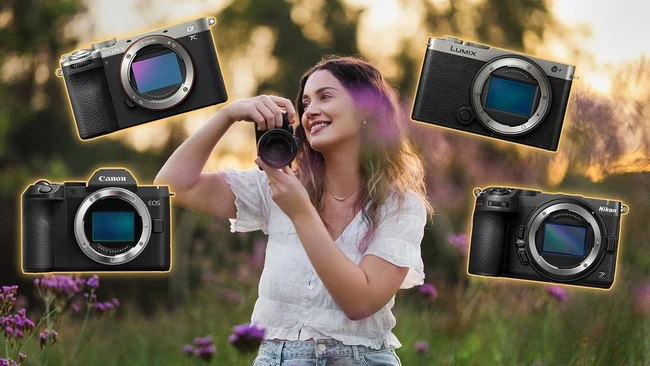
Which Small Full Frame Camera Is Worth Your Money?
The Canon EOS R8 Mark II, Sony a7C II, Nikon Z5IIC and Panasonic Lumix S9 are each their maker’s smallest and least expensive full-frame body, but their compromises suit different photographers. The Nikon and Canon are heavier yet easier to hold because of their deeper grips, while the S9 is smallest and can accept an optional grip. The Canon and Sony include viewfinders; the Lumix lacks both a viewfinder and weather-sealing. All use one UHS-II card slot. The Z5IIC has a full mechanical shutter, the S9 is electronic-only, and the Canon and Sony use electronic first curtain. All record full-width 4K 30p, but only Canon maintains full-frame 4K 60p. Lens motor performance also affects autofocus, so test the complete camera-and-lens combination before choosing a daily carry body.
Viltrox EVO 26mm f/2.8 Review: My Kind of Pancake
Viltrox’s EVO 26mm f/2.8 is a $299 full-frame pancake lens for Sony E and Nikon Z mounts, weighing just 4.5 ounces (130 grams). Its aperture ring, solid hood, 43mm filter thread and magnetic cap make it an especially travel-friendly companion, while the 26mm view works for landscapes, tight interiors and street scenes. The lens is sharp in the center at f/2.8, with softer extreme corners that improve when stopped down, and it can focus to 0.2m for approximately 1:5 reproduction. Its weaknesses include a stiff, hard-to-find manual-focus ring, a relatively slow and slightly noisy stepping motor, distortion corrected automatically, and flare when pointed toward bright light. Keeping the hood mounted and stopping down when needed will help preserve contrast.
Why this macro photographer shoots carnivorous plants with a 50-year-old Pentax lens
A macro photographer uses a Panasonic S1R and 50-year-old Pentax lenses to photograph carnivorous plants, treating their delicate flowers and elaborate traps as subjects that require both scientific attention and creative interpretation. The combination connects a modern high-resolution camera with vintage optics, allowing the work to balance fine botanical detail against imaginative close-ups. The project demonstrates that a lens does not need to be current to contribute a distinctive visual character: older Pentax glass can become part of the photographer’s method when paired with a capable digital body. For photographers exploring macro subjects, the practical lesson is to consider how camera resolution and the rendering of older lenses can serve different aspects of the same image.