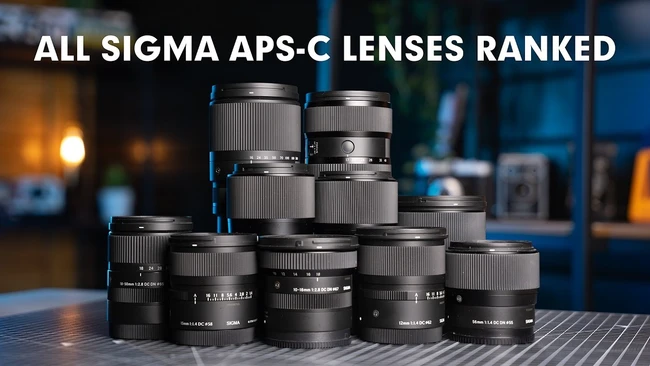
Which Sigma APS-C Lens Should You Actually Buy?
Sigma now offers 10 lenses for APS-C mirrorless cameras, spanning $344 to $919, but the overlap between primes and zooms makes choosing by specifications alone difficult. The 18-50mm f/2.8 DC DN Contemporary is the compact general-purpose option at about $579, while the 10-18mm f/2.8 costs $729 and suits interiors, street work, and vlogging. The standout is the 17-40mm f/1.8 DC Art at $919: it keeps f/1.8 throughout the range but weighs nearly twice as much as the 18-50mm. Other options include the 56mm f/1.4 for portraits and street work, the 16-300mm for one-lens travel, and several wide primes. Before comparing sensor formats, calculate each lens’s crop-equivalent view and depth-of-field effect.
Tamron Offers Nikon Z Owners a One-of-a-Kind Wide-Angle Zoom Lens
Tamron is bringing its compact 20-40mm f/2.8 Di III VXD standard zoom to Nikon Z full-frame mirrorless cameras later this month. The lens weighs 380 grams, measures 88.7mm, uses 67mm filters, and offers a 94°30′ field of view at 20mm. Its 20mm starting point favors landscapes and vlogging, while 40mm suits everyday photographs and portraits. VXD autofocus is designed to be fast, precise, and quiet, and minimum focus is 0.17m at 20mm with 1:3.8 magnification. On APS-C Nikon bodies, the range becomes approximately 30-60mm equivalent. The combination is unusual in Nikon Z: Nikon’s 14-30mm f/4 S is wider but slower, while the 24-50mm kit zoom is less wide and slower. For Z users, the practical appeal is a fast, portable lens spanning wide scenes to normal perspectives.
This tiny new Sigma f/2.8 telezoom should be on every APS-C user’s wish list
Sigma has announced a new 50-120mm f/2.8 lens for Canon, Fujifilm, and Sony APS-C users, adding a fast telezoom option to those systems. The announcement also brings Sigma’s existing 16-300mm f/3.5-6.7 DC OS zoom to Nikon Z shooters. The supplied information does not include prices, dimensions, optical construction, autofocus details, or availability for the new 50-120mm, so its practical position cannot yet be judged against the rest of each mount’s lineup. The basic distinction is clear: the 50-120mm emphasizes a constant f/2.8 aperture in a telephoto range, while the 16-300mm prioritizes enormous focal-length coverage. Photographers should wait for the missing specifications before deciding whether the new telezoom’s brightness outweighs the flexibility of a superzoom.