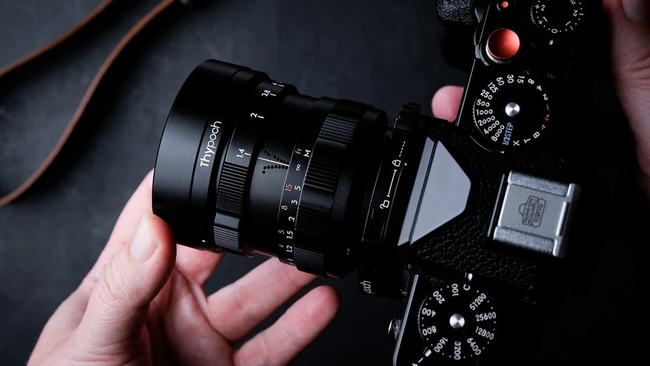
How Sharp Is the Thypoch Simera 75mm f/1.4 Wide Open?
The Thypoch Simera 75mm f/1.4 is a manual-focus Leica M-mount short telephoto in an all-metal body, tested on Nikon Zf and Fujifilm X-series cameras. On the Zf’s 24-megapixel full-frame sensor, its center is sharp at f/1.4, while corners improve to edge-to-edge sharpness by f/4. On Fujifilm’s APS-C bodies, the lens frames like roughly a 112mm equivalent and needs f/2 to match the Zf’s wide-open result. Chromatic aberration and vignetting are visible at maximum aperture, while focus breathing, no weather sealing, and openings near the focus scale require care. The de-clickable aperture ring suits video, but breathing complicates focus pulls. Adapted-lens users should enter 75mm for stabilization and combine focus peaking with magnification.
Huawei Launches an Entire Camera You Put On a Phone
Huawei has introduced the Ruiying Z10, an add-on camera module that attaches to two Mate 90-series phones: the Mate 90 Pro Max Collector’s Edition and Mate 90 RS. Unlike a simple teleconverter, it contains its own 50-megapixel Type 1 RYYB sensor and a 24-240mm equivalent f/2-4.5 power zoom, built from a 9.1-91mm lens with a 2.6x crop factor. The module uses the phone for power and processing but operates as a largely self-contained camera, attaching through a screw-on mount. Its 10x zoom changes focal length smoothly and continuously, and the lens contains 19 elements in six groups. At nearly 350 grams and 5,999 RMB in China, it adds real bulk and cost; its appeal is a larger sensor and lens than a phone can normally accommodate.
Wow – add on lenses for phones are actually good now! This has got to be the end for big cameras, right?
An opinion piece revisits the changing reputation of add-on phone lenses, asking whether telephoto and other attachments have become good enough to challenge larger cameras. The supplied material does not identify a specific product, publish specifications, or claim that smartphones have replaced interchangeable-lens systems. Its useful question is therefore about the threshold photographers use when judging compact equipment: whether an accessory delivers sufficiently capable focal-length coverage and image quality for a particular assignment. The argument also cautions against treating a provocative headline as a technical conclusion. For working photographers, the practical takeaway is to assess each add-on by the images and situations it can genuinely handle, rather than assuming either that phone accessories are still merely gimmicks or that larger cameras are obsolete.