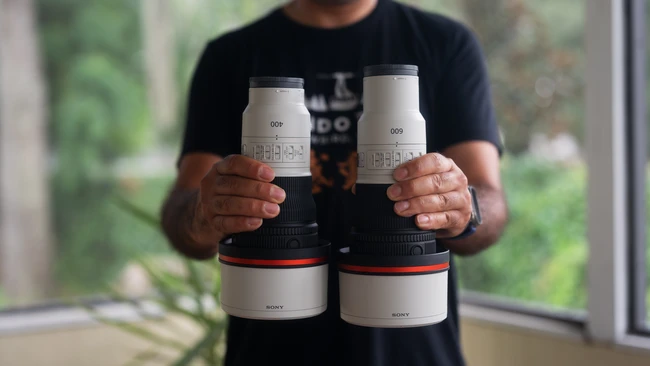
Sony FE 400mm f/4.5 and 600mm f/6.3 Hands-On: Super-Telephoto Reach Without the Weight
Sony’s FE 400mm f/4.5 GM OSS and FE 600mm f/6.3 GM OSS are unreleased super-telephoto primes designed to reduce the burden of wildlife photography from a vehicle. Both weigh under 1,000 grams without their tripod feet: approximately 994 g for the 400mm and 995 g for the 600mm. A redesigned optical layout shifts the center of gravity toward the camera, while internal focusing keeps their dimensions constant. Each uses two XD Linear Motors, three Super ED elements, one ED element, an 11-blade aperture, Nano AR Coating II and Optical SteadyShot with three modes. In hands-on testing, stabilization Mode 3 proved particularly useful for tracking and panning. For photographers confined to a car, the main advantage is easier handheld movement without abandoning long-reach prime lenses.
The Sony FE 400mm f/4.5 GM OSS Is the Lightest and Most Affordable of its Kind
Sony has announced the FE 400mm f/4.5 GM OSS alongside the FE 600mm f/6.3 GM OSS, positioning the 400mm as a particularly accessible G Master telephoto. It weighs 994 g without its removable tripod foot, measures 242 mm and accepts 95mm filters. Sony lists a $2,699 price, below the Nikon Nikkor Z 400mm f/4.5 VR S at $3,496.95, while also weighing about 14% less. Compared with Sigma’s 500mm f/5.6 DG DN OS Sports, the Sony offers less reach but is over 370 g lighter and avoids that third-party lens’s 15 FPS AF-C restriction on E-mount bodies. Weather resistance, four customizable Focus Hold buttons and a programmable function ring add operational flexibility. It gives Sony shooters a comparatively light, lower-cost route into a 400mm G Master prime.
Sony’s new pro-spec long lenses for sports and wildlife are startlingly lightweight – and we’ve tested them
The practical test of Sony’s new 400mm f/4.5 and 600mm f/6.3 GM primes centers on a difficult wildlife scenario: an 11-mile drive where photographers remain inside their vehicles while tracking gators, herons and ospreys. Traditional 400mm f/2.8 and 600mm f/4 primes provide faster apertures but are far harder to pan from a passenger seat. Sony’s alternatives keep both focal lengths below 1 kg, with the front element arrangement moving the balance rearward for more comfortable handheld use. Their twin XD motors support autofocus on irregularly moving subjects, while three Super ED elements and one ED element control chromatic aberration. The 11-blade aperture, lens calibration and Nano AR Coating II target smooth backgrounds and backlit scenes. These lenses favor mobility and handling when access, rather than image quality, is the limiting factor.