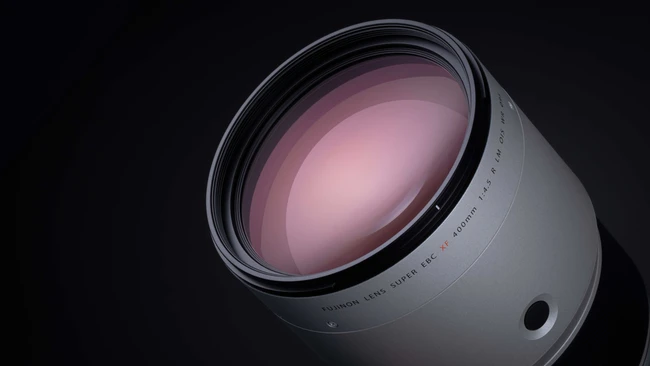
Fujifilm's New XF 400mm f/4.5 Offers 609mm-Equivalent Reach at Just 2.74 lbs
Fujifilm has announced the Fujinon XF 400mm f/4.5 R LM OIS WR, a super-telephoto prime for its X Series cameras. Its 400mm focal length produces an approximately 609mm full-frame equivalent view, while the lens weighs about 1,245g (2.74lb). The f/4.5 lens includes optical stabilization rated at 5.5 stops, linear autofocus, weather sealing and a design using 21 elements in 14 groups, including four ED and two Super ED elements. It accepts Fujifilm’s XF 1.4x and 2x teleconverters, extending the focal length to 560mm or 800mm—approximately 853mm or 1,219mm equivalent. For wildlife, birds, sports and aircraft, it offers substantial reach without requiring a second super-telephoto lens, although photographers should still plan around the subject distance and added converter size.
Fujifilm Bolsters Its XF Telephoto Lens Line with a 400mm f/4.5
Fujifilm’s XF400mm f/4.5 R LM OIS WR expands the company’s long-lens offering with a 609mm full-frame-equivalent field of view on X Series bodies. The lens is aimed at distant, fast-moving subjects such as birds, wildlife, vehicles and aircraft, and joins Fujifilm’s 200mm f/2 and 500mm f/5.6 in a telephoto lineup spanning roughly 305mm to 762mm equivalent. Its optical construction uses 21 elements in 14 groups, including four ED and two Super ED elements, while the nine-bladed diaphragm works from f/4.5 to f/22. Fujifilm says the 1,245g lens balances its weight near the middle for more comfortable handheld use. Twenty sealing points support dust and weather resistance, and operation is rated down to -10°C, though there is no official IP rating. That combination favors extended outdoor sessions where reach and handling both matter.
Tough new DJI Osmo 360 II camera can be frozen, dunked, ridden hard and more
DJI has announced the Osmo 360 II, a compact 360-degree camera built around a 1-inch sensor capable of recording 8K video at 60 frames per second. The camera also introduces AI features intended to assist in low-light conditions and uses replaceable lenses, while its design is presented as able to withstand freezing, immersion and demanding riding. The supplied announcement does not specify the depth rating, operating temperature or the exact low-light processing method, so those details remain important questions for photographers planning outdoor work. The larger sensor and high-resolution capture point toward a camera designed for detailed action and immersive footage, while replaceable lenses could make damage easier to address in rough environments. For riders, adventurers and action shooters, the practical advantage will depend on how those durability claims translate to their particular conditions.